• Home
  • Me & Black SF
  • SF Examples
  • Blk Wm & Comics
  • Podcasts/Videos
  • Articles/Blogs
  • Books/Publications
  • Speaking Engagements
  • FB - Black Girls Write the Future Group
  • Curriculum Vitae
  • Contact
  • Home
  • Me & Black SF
  • SF Examples
  • Blk Wm & Comics
  • Podcasts/Videos
  • Articles/Blogs
  • Books/Publications
  • Speaking Engagements
  • FB - Black Girls Write the Future Group
  • Curriculum Vitae
  • Contact
Search

Hail to the Queens, VIOLA DAVIS and ANGELA BASSETT- Who Received No Oscar Nods at this year's  95th Academy Awards?

5/2/2023

0 Comments

 
Picture
Picture
Picture
Picture
Picture
Picture
NOTES
[1] The British Academy of Film and Television Arts (BAFTA) nominated Davis for Best Leading Actress along with Prince-Bytewood in the category of Best Director.  The Warrior King also received nominations from the Film Critics Awards, NAACP Image Awards, Satellite Awards, American Film Institute (AFI) Awards, the Golden Globes, Screen Actors Guild Awards, Critics Choice Awards, among a voluminous list of others.  Wins were received from the Black Film Critics Circle Awards, the Critics Choice, NAACP Image Awards, Black Reel Awards, and AFI, to name a few--wins for Best Picture/Movie of the Year, Actress (Davis) and Directing (Prince-Bythewood), with members of the ensemble cast, and those working behind the scenes in editing or cinematography also garnering accolades. ​

[2] Bassett won the NAACP Image awards for both 9-1-1 and Wakanda Forever, along with the BAFTA, Hollywood Critics Association, Golden Globe, Critics Choice, and Black Reel Awards for her lead role as Queen Ramonda.  

[3] The Black female actresses who have received Oscars, all for a supporting role:  
Hattie McDaniels (Gone With the Wind (1945)), Whoopie Goldberg (Ghost (1991)) Jennifer Hudson (Dreamgirls (2007)), Mo’Nique (Precious (2010)), Octavia Spencer (The Help (2012)), Lupita Nyong’o (12 Years a Slave (2013)),Regina King (If Beale Street Could Talk (2019)), and Ariana DeBose (West Side Story (2022))​.
Works Cited
9-1-1.  Creators Brad Falchuk, Tim Minear, and Ryan Murphy.  Reamworks/Ryan Murphy Television/20th Century Fox Television, 2018-2023.

“Afrofuturism:  A History of Black Futures.”  National Museum of African American History and Culture.  Smithsonian.  https://nmaahc.si.edu/explore/exhibitions/afrofuturism.  Accessed 2 May 2023.

American Horror Story.  Brad Falchuk and Ryan Murphy.  FX Network/Brad Falchuck Teley-Vision/Ryan Murphy Productions, 2013-2018.

Black Panther.  Director Ryan Coogler.  Marvel Studios/Walt Disney Pictures, 2018.

Black Panther:  Wakanda Forever.  Director Ryan Coogler.  Marvel Studios/Walt Disney Pictures, 2022.

Boyz n the Hood.  Director John Singleton.  Columbia Pictures, 1991. 

Braveheart.  Director Mel Gibson.  Icon Entertainment International/The Ladd Company/B.H.Finance C.V., 1996.

Chi-Raq.  Director Spike Lee.  40 Acres & A Mule Filmworks/Amazon Studios, 2015.

Cho, Kelly Kasulis.  “The Oscars were a milestone for Asian artists:  ‘This is a beacon of hope.’”     Washington Post.  The Washington Post, 1996-2023.  https://                        www.washingtonpost.com/movies/2023/03/13/oscars-michelle-yeoh-asian-winners/#.              Accessed 25 April 2023.  

Contact.  Director Robert Zemeckis.  Warner Bros./South Side Amusement Company, 1997.

Doubt.  Director John Patrick Shanley.  Goodspeed Productions/Scott Rudin Productions, 2009.

The Elephant Whisperers.  Director Kartiki Gonsalves, Sikhya Entertainment, 2022.

Everything Everywhere All at Once.  Directors Daniel Kwan and Daniel Scheinert.  A24/IAC Films/AGBO, 2022.

Fences.  Director Denzel Washington.  BRON Studios/Escape Artists/MACRO, 2017.

Green Lantern.  Director Martin Campbell.  Warner Bros./De Line Pictures/DC Entertainment, 2011.

Glory.  Director Edward Zwick.  TriStar Pictures/Freddie Fields Productions, 1989.

“Halle, Denzel Make Oscar history.”  March 24, 2002.  ABCNews.  ABC News Internet Ventures, 2023.  https://abcnews.go.com/Entertainment/halle-denzel-make-oscar-history/story?            id=101254.  Accessed 25 April 2023.

The Help.  Director Tate Taylor.  DreamWorks/Dreamworks Pictures/Reliance Film & Entertainment, 2012.

The Last Samurai.  Director Edward Zwick.  Watner Bros/Bedford Falls Company/Cruise- Wagner Productions, 2004.

London Has Fallen.  Director Babak Najafi.  Millennium Films/G-BASE/Gramercy Pictures, 2016.

Malcolm X.  Director Spike Lee.  Largo International N.V./JVC Entertainment Networks/40 Acres & A Mule Filmworks, 1992. 

Ma Rainey’s Black Bottom.  Director George C. Wolfe.  Escape Artists/Mundy Lane Entertainment/Netflix, 2021. 

Mission Impossible:  Fallout.  Director Christopher McQuarrie.  Paramount Pictures/Skydance Media/TC Productions, 2018.

Montalván, Karla.  “From Best Actress to Best Picture, Hispanics And Latinos Have Taken Over the Oscar Nominations.”  Febrero 09. 2022.  People.  Meredith Latino Network, 2023. https://peopleenespanol.com/chica/hispanic/.  Accessed 25 April 2023.

Napolitano, Laura, ed.  Preview.  Spring/March-May 2023.  North Carolina Museum of Art (NCMA).

Olympus Has Fallen.  Director Antoine Fuqua.  Millennium Films/G-BASE, 2013.

The Patriot.  Director Roland Emmerich.  Columbia Pictures/entropolis Entertainment/Mutual Film Company, 2001.

RRR.  Director S.S. Rajamouli.  DVV Entertainment, 2022.

Supernova.  Director Walt Hill.  Hammerhead Productions/Metro-Goldyn-Mayer (MGM)/ Screenland Pictures, 2000.

Vampire in Brooklyn.  Director Wes Craven.  Eddie Murphy Productions/Paramount Pictures,         1995.

Waiting to Exhale.  Director Forest Whitaker.  Twentieth Century Fox, 1995.

What’s Love Got to Do with It.  Director Brian Gibson.  Touchstone Pictures, 1993.

The Woman King.  Director Gina Prince-Bythewood.  TriStar Pictures/Eone Entertainment/TSG Entertainment, 2022.

     Angela Bassett and Viola Davis are two exceptional actresses with extraordinary careers:  Bassett with over a hundred productions in film, tv, and voice-over work, while also directing and producing;  Davis with similar hallmarks as both an actor, director, and producer, while providing voice-/sound-work. Aptly, audiences watched to see the acknowledgements the Academy would confer on them this year. 

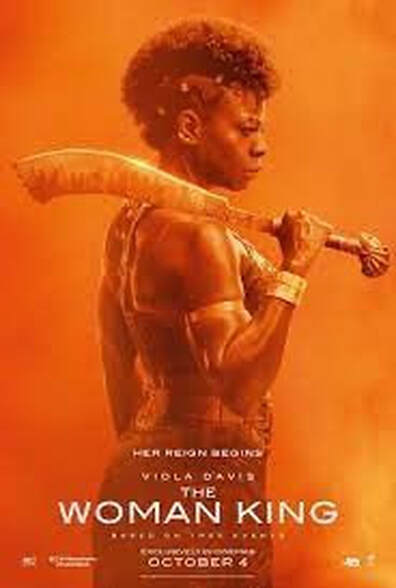
​   Shockingly, Davis, a member of the coveted EGOT world--those awarded the highest achievements in entertainment:  Emmy, Grammy, Oscar, and Tony--was shunned.  Being the most nominated actress of African-descent to receive Oscar nominations:  Best Actress in a Leading Role for Ma Rainey’s Black Bottom (2021) and The Help (2012);  and Best Supporting Actress for Fences (2017) and Doubt (2009), she walked with the golden statue for Fences.  However, she has, yet, to join Halle Berry as another Women of Color to be recognized for work in a leading role.  Considering these accolades, it is all the more disconcerting that Gina Prince-Bythewood’s The Woman King did not receive multiple nominations, not just for Leading Actress, but also, Directing, Makeup and Hairstyling, Best Picture, Writing (and so on)?  The film did receive such recognition from other venues.[Note1]  I offer such a thought because similar new historicist films like Braveheart (1996), The Last Samurai (2004), The Patriot (2001), Glory (1989) did receives nods from the Academy, not only in terms of nominations but also with wins.  What is the difference...female director...chronicling the height of civilization on the continent of Africa at the start of colonization...the military leadership of women? 

    Clearly, if we allow the facts to speak for themselves, Woman King defies every patriarchal norm, captured in the oxymoronic nature of the film’s title.  We have woman queens and male kings, not the inverse, and so even though Prince-Bythewood’s text offers a factual context for how/why the mythical monarchy of Wakanda would have a Dora Milaje, such truth may have been too unsettling for the Academy membership--at least to be recognized and rewarded.  What a disappointing revelation to have in 2023.  For, in terms of big screen action, storyline, character relationships and development, and most significantly for Davis--the daunting physical, psychological, and emotional demands on the lead actor--there is little difference between elements found in The Woman King that resulted in big wins for other films (ex., Gibson’s combat scenes in a kilt;  Washington’s race across the battlefields, dropping his weapon to pick up the American flag;  Cruise’s mastering of a samurai sword, and so on). 

       In regards to Bassett, who could not understand her disappointment in hearing Jamie Lee Curtis’s name announced for the Best Actress in a Supporting Role?  Mind you, I, too, am a Curtis fan, having watched her father’s films on tv as a child and seeing fans gravitate to every reiteration of the Halloween plot-twists.  In this regard, I am happy for Curtis, who also has a loooong movie career with some interesting roles, but is Deidre Beaubeirdre’s character really that enduring or memorable?  No one will forget Queen Ramonda and the legacy she reflects as Queen-Mother of the Black Panthers:  T’Challa and Shuri!  Here-in, Bassett may have happened upon that once-in-a-lifetime, pinnacle,  “je ne sais quoi” moment in her career.  I, certainly, will never forget her bereaved speech about “having given everything.”  You could hear a pin-drop in the theater, and all were equally overcome when she gave her life to save Riri Williams/Ironheart.  Were such spellbinding moments created by Curtis in Everything Everywhere All at Once?  In addition, Bassett’s rendition of Queen Ramonda comes after so much other, brilliant work:  Athena Grant in 9-1-1 (2018-2023);  Marie Laveau, Desiree Dupree, Ramona Royale, Lee Harris, and Monet Tumuslime in American Horror Story (2013-2018);  Erika Sloane from Mission Impossible:  Fallout (2018);  Lynne Jacobs in London Has Fallen (2016) and Olympus Has Fallen (2013);  Miss Helen in Chi-Raq (2015);  Doctor Waller in Green Lantern (2011);  Dr. Kaela Evers in Supernova (2000);  Rachel Constantine in Contact (1997);  Tina Turner in What’s Love Got to Do with It (1993).  What these roles have in common--and note, I haven’t mentioned her celebrated roles as a mother, wife, or love-interest in popular Black films like Boyz n the Hood (1991), Malcolm X (1992), Vampire in Brooklyn (1995), or Waiting to Exhale (1995)--are representations of powerful, enduring, and endearing women who are unwavering in the face of insurmountable odds.  Do you see the point?  In essence, Bassett has played indomitable personalities for decades and, finally, she happened upon a striking part that was perfect for her and this moment in time.  (Consider Ruth Carter’s receiving a second Oscar for her costuming designs for Black Panther:  Wakanda Forever, with productions on display in the Smithsonian’s National Museum of African-American History and Culture (NMAAHC) special exhibit on Afrofuturism (“Afrofuturism”), along with North Carolina’s Museum of Art (NCMA) displaying her work from April-August of 2023 in their “Ruth E. Carter:  Afrofuturism in Costume Design” (Napolitano)).  For these reasons, the Academy must be commended for Bassett’s nomination but why not the win, accolades she did receive elsewhere? [Note 2]

    Yet, again, I don’t want paranoia and conspiracy theories to reign, but it seems as if the status quo does not want women of African-descent to have a monarchal presence.  Even so, we are rightful heirs to this unprecedented fact.  We are Nefertiti, Cleopatra, Makeda, Sheba.  They are our cultural and historical ancestors, and no matter how much the image is thwarted or transferred to another (casting these characters as non-representative women of African-descent), the remnants remain.  For me, then, it was disheartening to not see Davis’s face with Michelle Yeoh’s, when the majority group of Anglo-descended women were named for Leading Lady and for Bassett’s name to not be read for the winner in the role of Best Supporting Actress.  Such an observation takes nothing away from the brilliant performances the other actors gave in their range of riveting roles.  The conundrum remains, however;  there seems to be a comfort in seeing and applauding women in the trials that they surmount, but Women of Color, especially those who are African-descended, should not reflect royalty.  [See NOTE 3, which lists the Black female actresses who have received Oscars, all for a supporting role.]. Thus, whether this is the intended message or not, an impression is being sent that 1) Women of African-descent can't be Oscar-award-winning Leading Ladies, and 2) they can't be captured as sovereign.  Such an impressions is only compounded by the absence of Oscar nods to two queens, literally and figuratively (or one queen and a woman king) at the 95th Academy Awards celebration. 

    Fortunately, for the Asian-American community, this was a laudable year, with wins for an Actress in a Leading Role (Yeoh);  Supporting Male Actor (Ke Huy Quan);  the many other wins for Everything Everywhere All at Once (7 oscars, including Best Picture, Best Screenplay, and Best Director); along with Indian artists, M.M. Keeravani and Chandrabose, for “Naatu Naatu” (from the film RRR);  and another Indian documentary, The Elephant Whisperers, which “made history as the first Indian documentary short” (Cho).  Honestly, I might have voted for Yeoh, myself, but Davis definitely should have been a contender.  Embracing diversity along these lines is valuable and necessary, but the precedence remains:  why must it be one or the other--Black wins (ex. Halle Berry’s Lead Actress, Denzel Washington’s Leading Actor in 2002, the same year that Sidney Poiter was given a second Oscar for Lifetime Achievement (“Halle, Denzel”)), an overwhelming number of nominations for LatinX creators in 2022 (Montalván), and Asian achievement (this year)?  Such a conundrum was all the more pronounced in having Berry--in Will Smith’s absence--announce this year’s winner for Lead Actress.  In other words, in light of Smith’s debacle last year--for which he should have been ejected from the ceremony with no chance to deliver an acceptance speech and, perhaps, anticipating the acrimony that would arise in shunning Davis, Bassett, and Prince-Bythewood--the Academy leadership subtlety and problematically sent a message that said, “Let’s not forget the history that was made at the 74th Awards ceremony, twenty-one years ago, when Black Excellence was celebrated.  Unfortunately, in 2023, we should no longer have to look at achievement in such divisive terms.  Wouldn’t it be wonderful to see talent applauded without the woeful appearance of one demographic being singled out over another.
0 Comments


Leave a Reply.

    Author

    Karima K. Jeffrey, Ph.D.

    Archives

    May 2023
    February 2023
    January 2023
    October 2022
    August 2022

    Categories

    All

    RSS Feed

Proudly powered by Weebly
  • Home
  • Me & Black SF
  • SF Examples
  • Blk Wm & Comics
  • Podcasts/Videos
  • Articles/Blogs
  • Books/Publications
  • Speaking Engagements
  • FB - Black Girls Write the Future Group
  • Curriculum Vitae
  • Contact